
Wayne County Three-Day Release Fallback
The official source sweep found no Wayne County 72-hour release page, released tab, public roster archive, or fixed three-day report. The county sitemap and legacy sheriff navigation were checked. Neither offered a rolling release window. No official field list, photograph indicator, refresh schedule, delay estimate, or online retention period is published. A commercial listing cannot fill that evidence gap because it may mix places, dates, or custody systems.
The official Wayne County sitemap is useful evidence of the current public page inventory.
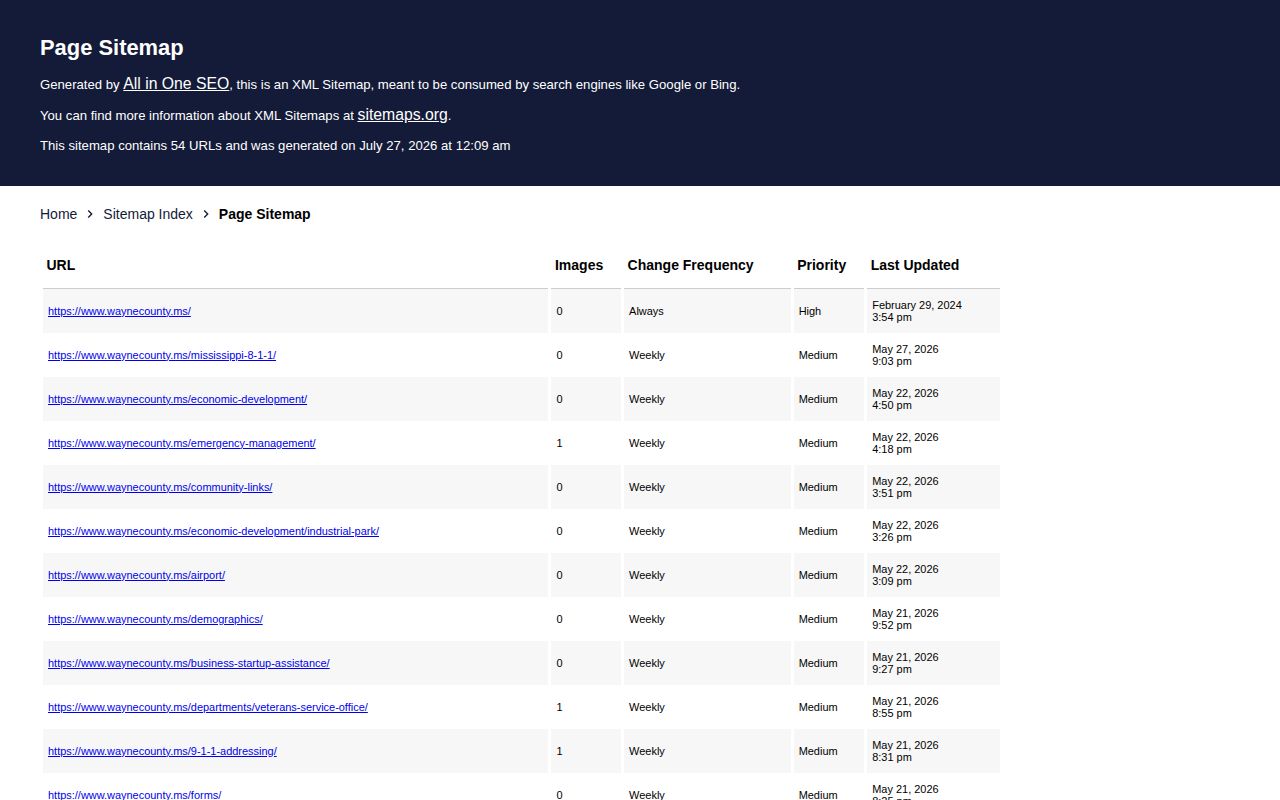
The inventory supports the absence finding, while the sheriff's written jail record remains the source for an actual Wayne County release.
For a three-day check, contact the Wayne County Sheriff's Office at 601-735-3801. Ask for bookings recorded as released, discharged, or transferred between two exact dates and times. Request the jail-docket entry and release sheet tied to each relevant booking. If a penitentiary transfer occurred, seek the receiving officer's receipt. The legacy detention number is 601-735-2323, but callers should begin with the current county contact and ask which channel handles written jail-record requests.
Check Wayne County 72-Hour Releases
A three-day inquiry should preserve each event's own time and source. Do not group all departures under a loose phrase such as “released over the weekend.” One person may have posted bond, another may have completed county time, and a third may have moved into MDOC custody. All three left Wayne County possession, but only the first two examples may describe a return to the community.
- Set exact boundaries. Give the starting and ending date and time for the 72-hour period, including the correct local dates.
- Identify the booking. Supply the full name, approximate arrest date, and booking number when known.
- Ask for existing county records. Request the jail-docket entry, release sheet, and any transfer receipt for a booking that ended in the window.
- Separate disposition from destination. Read both how the episode ended and whether another agency received the person.
- Match a court event. Obtain the filed bond, dismissal, sentencing, or release order when the legal reason needs confirmation.
- Check the named receiver. Use MDOC, BOP, or ICE only when the custody chain points to that system.
The Released Last 24 Hours page narrows the same-day task and covers pickup logistics. For a known person's full custody path beyond a rolling period, Home organizes the county, court, state, and notification checks.
Note: Write down the retrieval time for every source because a court order, jail entry, VINE event, and receiving-agency record can reflect different stages.
Wayne County Release Docket Fields
No web feed means there are no verified online columns for a Wayne County 72-hour list. The permanent jail docket is more useful than an invented set of feed fields. It records admission and discharge facts that can be requested for the full three-day interval. Ask for records already maintained by the sheriff rather than requesting a new custom report.
| Record item | Why it matters in a 72-hour review |
|---|---|
| Prisoner's name | Provides the starting identity match for the booking. |
| Date of arrest and commitment | Distinguishes a new episode from a prior jail stay. |
| Cause and authority | Links confinement to its warrant, mittimus, or other authority. |
| Length of imprisonment | Shows the duration recorded for that county episode. |
| Release or discharge method | Identifies how Wayne County possession ended. |
| Release warrant or order | Connects processing to the legal command behind it. |
| Receiving officer's receipt | Documents a penitentiary transfer instead of community release. |
Request the departure date and time, disposition, authority, and destination in plain terms. Pair the result with the booking number. If the answer says “released to MDOC,” report a county-to-state transfer. Search the MDOC inmate interface for the next custody stage. A person held only on a local matter may never have an MDOC entry, so a state no-result cannot erase the county record.
Weekend Wayne County Release Verification
A three-day period can cover Friday through Monday activity that a same-day inquiry misses. It can also capture a release event that was not immediately available when a family first called. Wayne County does not publish special weekend or holiday release hours, however. There is no verified rule showing that an authorized release will appear on a public list the next morning, because no such list was found.
Use the exact calendar interval. If staff say a court authorized release on one day but the jail entry shows departure on another, preserve both facts. Authorization and physical processing are separate stages. A second warrant, detainer, transfer arrangement, or routine processing can keep the person in custody after an order is entered. A detainer is a request or notice from another authority that can affect movement or release.
The Wayne County Circuit Clerk is the felony disposition custodian. The official court contact is Wayne County Courthouse, 609 Azalea Drive, Waynesboro, MS 39367, at 601-735-1171. Ask for a filed order, judgment, or docket reference rather than a broad account of the case. Justice or municipal material may be held elsewhere, so use the county courts directory when routing is uncertain.
Wayne County Release Records Outlast Feeds
Wayne County's missing online 72-hour view does not make old release facts unavailable. Mississippi's county retention schedule classifies the jail docket as permanent, and its listed content includes the date of discharge. The inmate case file lasts 25 years after release. The jail census or meal log contains incarceration and release date and time and follows a three-year-after-audit retention period.
These periods explain why a narrow written request is stronger than a rolling-page expectation. Ask for the permanent docket entry first. Add the release sheet and transfer receipt if the destination matters. If the precise time is missing from one record, ask whether the census or meal log for the interval contains it. Retention is not the same as open access to every detail, and exempt material may be redacted. Still, the discharge date's place in a permanent series gives a clear archival route.
- Jail docket
- The permanent county record tying confinement to release or discharge.
- Release sheet
- An operational record that may state when and how a booking ended.
- Transfer receipt
- Evidence that another corrections authority received the person.
- Court order
- The filed legal authority for bond, dismissal, sentence, or another disposition.
Note: An online publication window and a government retention period are different; Wayne County publishes no release-feed window, but source records endure.
Reconcile Wayne County Release Evidence
A three-day review often brings several systems into play. Each proves something different. The sheriff's docket or release sheet proves that the Wayne County booking ended. A filed court order explains the legal authority. A VINE event shows that a participating source transmitted a custody change. An MDOC entry can show that state custody followed. None should be stretched beyond its scope.
| Evidence | Supported conclusion | Important limit |
|---|---|---|
| Sheriff jail docket or release sheet | Wayne County physical custody ended as recorded. | The destination must be read before claiming community release. |
| Filed court order | The court authorized bond, dismissal, sentence, credit, or release. | Authorization may precede actual jail departure. |
| VINE event | A source transmitted a release or custody event. | It is not a certified release sheet or full legal reason. |
| MDOC record | State custody or supervision exists when the matching record says so. | It is not Wayne County's booking-and-release file. |
| BOP or ICE result | The matching federal or immigration system reports its own custody scope. | It does not prove all other custody ended. |
VINELink is most useful when set up before the expected event. Search the specific person and save the event label and time. A no-result can reflect a name mismatch, delay, nonparticipation, withholding, another custody system, or expiration from a recent-data window. Contact the source agency before drawing a conclusion.
Wayne County Release Types Differ
The same three-day interval can contain very different outcomes. Bond ends pretrial detention while the case continues, subject to conditions and other holds. Time served generally means credited custody matches the ordered jail time. A sentence-completed discharge ends the custodial term, although court duties or supervision may remain. A dismissal or acquittal changes or resolves a charge, but another matter can still keep the person confined.
Parole is conditional early release from imprisonment under the Mississippi State Parole Board's authority and usually includes MDOC supervision. Probation is a court-ordered community sentence or condition and is not proof that the person first left state prison. A transfer ends Wayne County's possession but not physical custody. These labels should be copied from the source record, then explained without changing them.
If the records conflict, note each retrieval time, identifier, field label, and custody scope. Ask the sheriff to correct county booking or release data, the clerk to address court entries, and MDOC to address its status fields. A VINE result cannot alter the source record. Conflicts often reflect different stages of the same movement rather than one false document.
Request Wayne County Release Records
A precise request reduces delay across a 72-hour span. Name the jail docket entry, release sheet, and transfer receipt. Provide the person's full name, approximate arrest or booking date, exact three-day period, and booking number if known. Ask for the date and time, disposition, authority, and destination already recorded. If a case number is available, include it because it helps connect the commitment or release warrant with the correct court matter.
For the clerk, name the document needed, such as a bond order, dismissal, judgment, amended judgment, revocation order, or release order. A broad request for every file can raise cost and review time while hiding the one record that answers the custody question. If the sheriff names a receiving agency, use that agency's identifier and request only the existing movement or discharge record needed to follow the chain.
Keep the response as received. If a later correction arrives, preserve both versions and the dates. This creates a clear account of what was known during the selected 72-hour period and what the record custodian later confirmed.