
Wayne County Supervision Types
Mississippi uses several forms of community supervision, and each one answers a different question. Parole is conditional release from a prison sentence. The Mississippi State Parole Board decides whether to grant it, while the Mississippi Department of Corrections, or MDOC, handles field supervision. Probation is imposed by a court, often instead of prison or as a condition tied to a suspended sentence. Earned Release Supervision, called ERS, permits an eligible state prisoner to live outside prison while still retaining offender or inmate status within MDOC jurisdiction.
These labels should not be blended. A probation order does not establish that someone left state prison. A parole eligibility date only opens the door to Board review. It does not prove the Board granted release. An ERS date is also conditional. MDOC must investigate a proposed in-state residence, and a detainer or other hold may prevent the planned move. Actual status should come from the record that created it.
| Status | Who creates it | Best confirmation |
|---|---|---|
| Parole | Mississippi State Parole Board | Board action sheet, MDOC parolee result, and office confirmation |
| Probation | Sentencing court | Filed judgment or probation order and local office routing |
| ERS | MDOC under earned-time law | MDOC record, case manager, and movement or release document |
| Discharge | Court, Board, or MDOC as applicable | Final order, discharge certificate, or supervision record |
- Parole
- Conditional community release from imprisonment before the full term ends.
- Probation
- A court-ordered community sentence or condition that may not follow prison.
- ERS
- Earned Release Supervision, an MDOC status outside prison but still under state jurisdiction.
- Detainer
- A request or hold from another authority that can delay release or change the destination.
Check Wayne County Parole Status
The official MDOC parolee search is the strongest public online sign that a former state prisoner is now on parole. It accepts a name or MDOC number and permits city or county filters. A matching result may show the person's name, MDOC ID, county, supervising officer, photograph, and a field labeled Flat Time Date. Keep that label intact. It is not safe to rename Flat Time Date as the person's release date.
Identity must be matched with care. Common names can collide, and a Wayne County supervision address does not prove release from the Wayne County Adult Detention Center. The underlying state prison may have been elsewhere. The conviction county can also differ from the supervision county. Use the MDOC number when known, then confirm office routing by phone.
- Search the parolee interface by exact name or MDOC number. Try a reasonable spelling variant if the first search fails.
- Compare the returned MDOC ID, county, city, and supervising officer. Do not rely on appearance alone.
- Call the Wayne Probation & Parole Office to confirm the correct reporting office. Do not ask for confidential agent notes.
- For parole, request the Board action sheet if the grant or denial must be documented. For probation, obtain the filed court order.
- When the status has ended, seek the discharge record instead of treating disappearance from a search as proof.
The MDOC parolee search screen shows the statewide starting point for a name or identifier lookup.
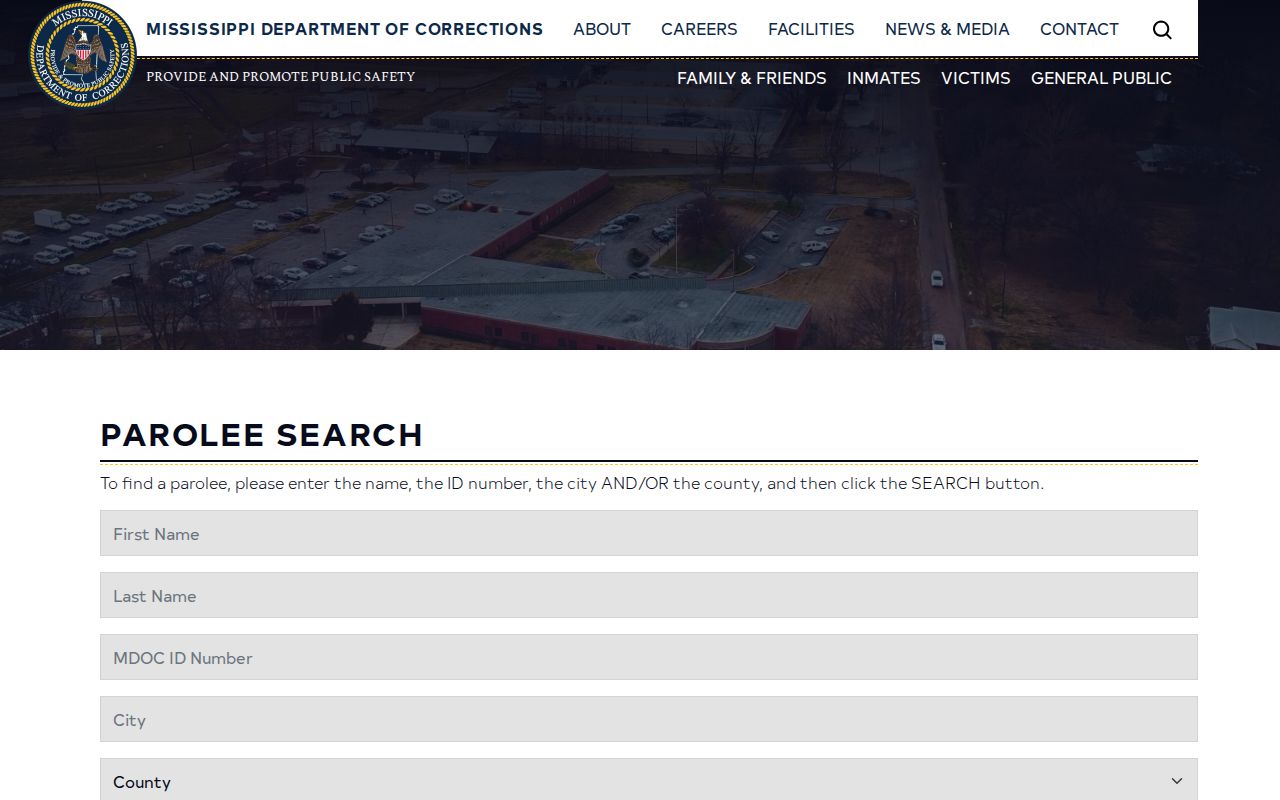
That interface concerns community parole in the MDOC system. It is not Wayne County's jail-release record and does not cover every form of probation or discharge.
Note: A missing parolee result may reflect discharge, transfer, revocation, delay, another legal status, or a name mismatch.
Wayne County Supervision Office
The current MDOC Wayne Probation & Parole Office listing names the local Community Corrections office at 610 Azalea Drive in Waynesboro. It lists Jason Carney as Community Corrections Director. Community Corrections agents conduct local supervision work, while the Parole Board makes parole decisions and the sentencing court controls probation orders.
Call before visiting. Published hours were not verified in the research, and the county and state pages disagree on one street number. The phone and fax match, which makes a call the sound way to confirm the correct entrance and current office schedule.
Wayne Probation & Parole Office610 Azalea Drive
PO Box 461
Waynesboro, MS 39367
Phone: 601-735-4826
Fax: 601-735-1385
Hours: Call to confirm
The official Wayne supervision-office page is the newer address source.
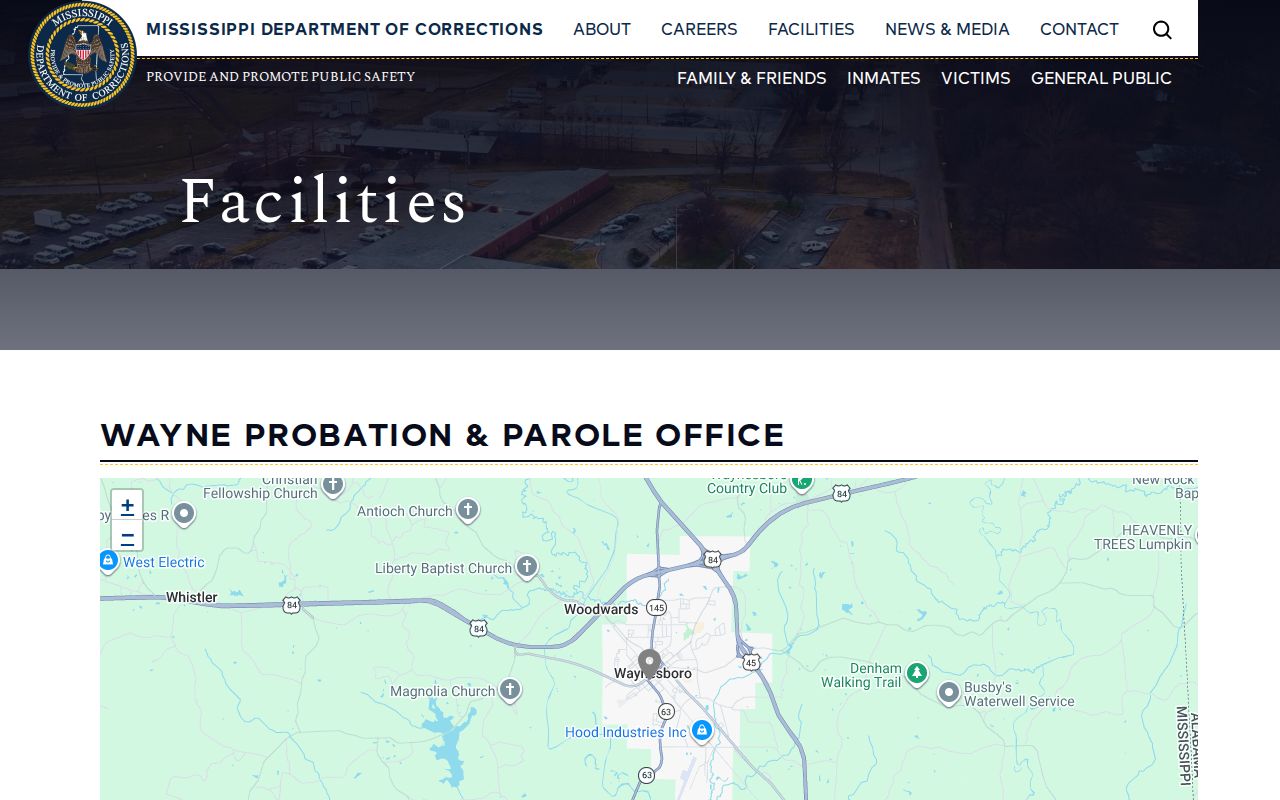
The listing helps route a Wayne County parole or probation inquiry, but an office directory by itself cannot confirm one person's status.
Confirm Wayne Supervision Address
Two official pages differ by one street number. MDOC lists 610 Azalea Drive. The Wayne County probation and parole page describes the courthouse first floor at 609 Azalea Drive. Both give phone 601-735-4826 and fax 601-735-1385. The difference may reflect mailing, building, suite, or older information, but the sources do not explain it.
Use the newer MDOC listing for written routing, then call before travel. The office can confirm its current entrance and whether an appointment is needed. This small check matters because a missed visit can have more serious consequences for a supervised person than for someone making a routine records inquiry. Do not assume the probation and parole office is a jail. It is a field office, not a place of detention.
Wayne County Parole Decisions
The Mississippi State Parole Board has authority to grant, deny, and revoke parole. Wayne County's local page says parole-eligible lists are generated each month and sent to the Board. Eligibility means a case can be considered. It does not guarantee a favorable decision or physical release.
No verified public, name-searchable decision portal or individual hearing calendar was found. The state parole agency page routes readers to official Board resources, while the durable individual path is the written action sheet. Mississippi Parole Board rules state that the inmate is advised in writing after deliberation. A denial should give reasons and a set-off, which is the period before the next hearing. A grant can still be followed by residence review, detainer checks, or processing before the person leaves prison.
The sequence is: eligibility → Board consideration → written action → release processing → parolee record → eventual discharge. Each point answers a different question. For the date estimate that precedes movement, see the Wayne County projected release date resource.
Wayne County Absconder Checks
An absconder is a person whom the supervising authority has formally classified as having stopped required contact or otherwise evaded supervision. No official statewide public absconder lookup or Wayne County parole and probation warrant list was verified. A name missing from the parolee search must not be relabeled as an absconder. The record could have moved, expired, changed, or failed to match.
Start with the local office and the authority that would issue or hold a warrant. MS SAVIN through VINE can send an absconding event when a participating source enters one, but that alert remains source-supplied. It does not create the warrant or correct the agency record. If there is an immediate safety issue, use the proper emergency channel. A public-record inquiry is not an emergency call.
Conditions also vary by order. The Wayne County page says an agent interviews a new probationer and supplies the conditions. Those directions, the filed court order, and later written changes control. General examples should never be used to claim that a named person violated a term.
Note: Confirm warrant or absconder status with the responsible authority; a negative search result cannot establish either one.
Wayne County Reentry After Release
Community supervision often begins while practical needs are still unsettled. The Southeast Mississippi Reentry Guide reports local Waynesboro referrals, including a substance-use rehabilitation program on Wayne Street and Wayne County Veteran Affairs. These are navigation leads, not proof that a service remains open or that any person qualifies.
Call first to confirm hours, intake rules, cost, and eligibility. The reported rehabilitation contact is at 1069 Wayne Street, 601-735-4522. Wayne County Veteran Affairs is reported at 609 Azalea Drive, 601-735-4258. A supervision officer may also identify approved programs when a court or MDOC condition requires one. Approval should come from the supervising authority, not from a directory listing.
Practical aid and legal status should remain separate. A program referral does not establish parole, probation, ERS, or discharge. Likewise, receiving community help does not alter the terms of a court or Board order.
Wayne Release Property Records
Mississippi's county retention schedule creates a distinct route for property disputes after a Wayne County jail release. Series GSC 08-16 retains an inmate property record for ten years after release. The record documents property received or confiscated at commitment and the return of nonconfiscated items when the person leaves custody.
This is a county jail record, not a supervision-office file. Ask the Wayne County Sheriff's Office for the property entry tied to the booking date and number. Name the item or dispute if possible. The permanent jail docket can confirm how the jail episode ended, while the property record addresses what was logged and returned. MDOC property from a state prison follows the state records path instead.
A narrow written request is easier to route than a demand for an entire inmate file. The Wayne County released-inmate search and records overview explains how to request the jail docket, release sheet, and related custody records.
Wayne County Supervision Discharge
Discharge means the applicable period of supervision has ended. The right proof depends on the source. For probation, request the court order or docket entry that closes or changes the supervision term. For parole or ERS, request the relevant MDOC or Board record. A completed Wayne County jail release is a separate event preserved in the sheriff's jail docket.
Disappearance from a public interface is not enough. A parolee result might vanish after discharge, move to another county, change after revocation, or fail because of a data issue. Record the search date, retain the exact field labels, and ask the creating office for a durable document. Field-agent records may be exempt under MDOC policy, so request the nonexempt status or discharge record rather than confidential supervision notes.
When records conflict, compare their custody scope and timestamps. A court may end one obligation while another hold remains. Parole may end before another registration duty. The precise order or certificate is stronger than a broad verbal summary.